Proven program, faithfully implemented
5/3/1 Boring But Big
Boring But Big is 5/3/1 with one supplemental idea bolted on: after the main percentage work, 5 sets of 10 of the same or an opposing lift. The main work is unchanged — the 5×10 is where the size comes from, and keeping its percentage conservative is what makes the template survivable.
About the program
Created by: Jim Wendler — 5/3/1 Boring But Big — jimwendler.com: Boring But Big.
Who it's for
- Best for: Size, without leaving the 5/3/1 main-lift progression that is already working.
- Experience: Intermediate to advanced. It is not a starting point — it assumes you already run 5/3/1 and know your training maxes.
- Time: Four-week cycles, three to four days a week. The supplemental volume makes sessions noticeably longer.
How it's built
The shape of the program — sessions, sets and rep scheme. Iron Forge fills in the exact weights for you from your maxes.
Cycle
Bench
- Barbell Bench Press — 2×5/3, 1×5/3/1+
- + 3 more exercises
Squat
- Barbell Squat — 2×5/3, 1×5/3/1+
- + 3 more exercises
Deadlift
- Deadlift — 2×5/3, 1×5/3/1+
- + 3 more exercises
Press
- Overhead Press — 2×5/3, 1×5/3/1+
- + 3 more exercises
How Iron Forge runs it
How it works
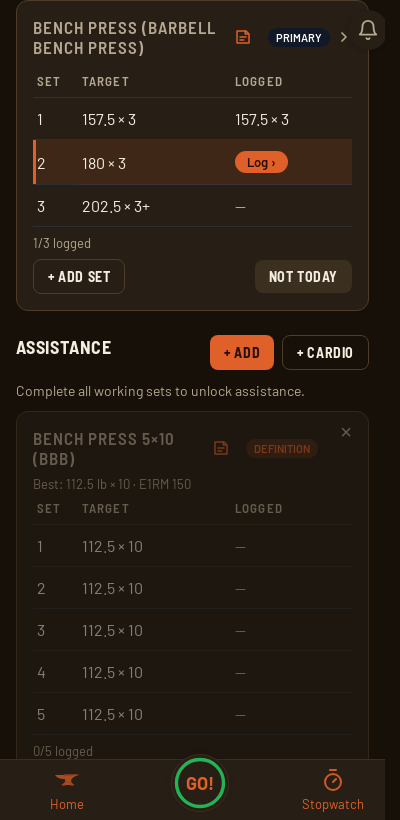
This is Jim Wendler's 5/3/1 run with the Boring But Big (BBB) supplemental template. You do the standard 5/3/1 main work — percentage sets off a ~90% Training Max across a 4-week cycle (5s, 3s, 5/3/1, deload) with an AMRAP top set — and then add 5 sets of 10 reps of the same (or an opposing) main lift at 50–60% of the TM. The main work builds strength; the BBB 5×10 piles on the size and work capacity.
Training max and progression
Set the TM to about 90% of your true 1RM. After each cycle add +5 lb2.5 kg to upper-body TMs and +10 lb5 kg to lower-body TMs. The BBB supplemental is run at a percentage of the TM too (start around 50%, build toward 60% over time) — resist going heavier, because 5×10 is already a large volume dose on top of the main work.
Running BBB sustainably
BBB is deliberately high-volume, so keep the supplemental percentage conservative and your assistance minimal (a little single-leg/core and pulling). Same-lift BBB (e.g. squat 5/3/1 then squat 5×10) maximises hypertrophy on that lift; opposite-lift BBB (squat main, then bench 5×10) spreads the fatigue. Eat and sleep for the volume.
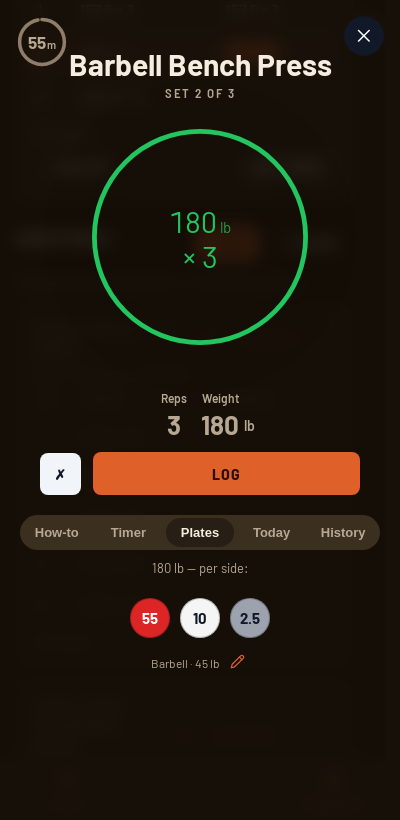
5/3/1 Boring But Big in Iron Forge
FAQ
- What is Boring But Big?
A 5/3/1 supplemental template: after your main 5/3/1 work you do 5 sets of 10 reps of a main lift at 50–60% of your Training Max. It's a simple, high-volume way to add size and work capacity.
- Should I do the same lift or the opposite lift for the 5×10?
Same lift — squat day gives you squats, bench day gives you bench. That is the classic version and it is what ships here. The opposite-lift variation exists and balances fatigue differently, but it is a different template rather than a setting on this one.
- What percentage should the 5×10 be?
50% of your training max, every week. Some people creep it toward 60% over several cycles, and this holds it at 50 rather than climbing on your behalf — five sets of ten is punishing enough that the weight should be a decision you make, not one made for you. If it feels too easy, it is probably doing its job.
- How does the main 5/3/1 progress?
Exactly as standard 5/3/1: add +5 lb2.5 kg (upper) / +10 lb5 kg (lower) to the TM each cycle; every percentage recomputes off the new TM. The AMRAP top set tracks your progress.
- Isn't 5×10 on top of 5/3/1 a lot of volume?
Yes — that's the point, and why you keep the supplemental light, your assistance minimal, and your eating/sleeping on point. If you're run down, drop the BBB percentage or frequency.
- Who is BBB best for?
Lifters who want to add muscle and work capacity while keeping the proven 5/3/1 strength base — intermediates who recover well and can eat for the extra volume.
- Why is the 5×10 so light in the deload week?
Because it gets the deload treatment too — around 30% of your training max in week four, against 50% in the working weeks. Week four is there to let you arrive at the next cycle fresh, and five sets of ten at the usual weight would undo that on its own.
- Does the 5×10 affect my training max?
No. Only the top set of week three does — the 1+ — and the supplemental work never counts, however well it goes. It is there to add size and work capacity underneath the strength work, not to measure you.
- How long does a run last?
Eight cycles by default, which is about eight months, and you can choose a different number when you start. This is a template you can live on for a long time; the count exists so the run has an end rather than because Wendler prescribes one.
Start 5/3/1 Boring But Big for free today.
Real programs, done right. Log your lifts — Iron Forge handles the maths.