Proven program, faithfully implemented
Top Set and Back-Off
Top Set and Back-Off takes an idea from Juggernaut Training Systems — one hard top set, then back-down volume — and autoregulates it. Each main lift opens with ONE top set at a prescribed effort; you log the reps and your RIR, and the back-off sets are then loaded from the weight you actually just used, not from a number chosen weeks ago. The top set moves on what you report, capped at 10% a session so one unusual day cannot run away with the block.
About the program
Created by: Juggernaut Training Systems (the method); this implementation by Iron Forge — Inspired by Juggernaut Training Systems' published writing on top sets and back-down work.
- Inspired by: Going Heavy on The Juggernaut Method — Chad Wesley Smith working up to a heavy top set, then a backdown set (Juggernaut Training Systems, 2013)
- Inspired by: Selecting and Progressing Your Weights — the modern JTS position on percentages vs RPE, which is the autoregulated form this programme follows (Juggernaut Training Systems, 2023)
- Method: How To Work Up To A Top Set — Marisa Inda and Chad Wesley Smith (Juggernaut Training Systems)
- Reference: Reps in reserve and RPE for autoregulation (Stronger by Science)
Who it's for
- Best for: Strength, when a fixed percentage plan keeps meeting a body that does not read the plan.
- Experience: Intermediate to advanced. It only works if you can judge reps in reserve honestly — the whole programme is loaded from that judgement.
- Time: Flexible. It is a way of running your main lifts rather than a block with an end date.
How it's built
The shape of the program — sessions, sets and rep scheme. Iron Forge fills in the exact weights for you from your maxes.
Wave
Squat
- Barbell Squat — 1×3, 3×6
Bench
- Barbell Bench Press — 1×3, 3×6
Deadlift
- Deadlift — 1×3, 2×5
Press
- Overhead Press — 1×3, 3×6
How Iron Forge runs it
How it works
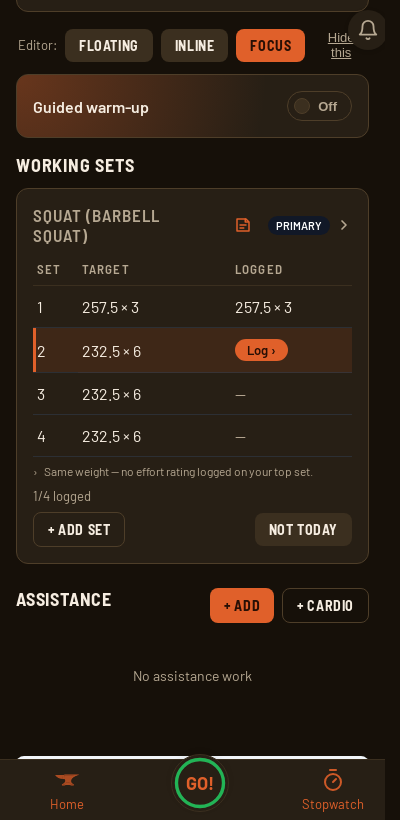
Each main lift opens with ONE top set at the prescribed effort. Log the reps and how many you had left in reserve, and the back-off sets are loaded for you at ~10% below the weight you actually used — not below a number chosen weeks ago.
Reps in reserve (RIR)
RIR is how many more reps you could have done. 2 RIR means you stopped two short of failure. If you think in RPE, RPE = 10 − RIR: RPE 8 is 2 RIR, RPE 9 is 1 RIR. The app prescribes and records RIR so there is one number, not two.
How the top set moves
Report more in reserve than asked and the next top set goes up; report less and it comes down; hit it exactly and it holds. Movement is capped at 10% per session, so one unusual day cannot run away with the block, and the load never rises on a session where you missed the prescribed reps.
If the back-offs feel wrong
They should land around RPE 7-8. If they feel nearly as hard as the top set the drop is too small; if they feel like warm-ups they are not providing stimulus. The published guidance is ~10% as a default and ~15% if you struggle to hit the target reps on them.
Top Set and Back-Off in Iron Forge
FAQ
- Why don't my back-off sets have a weight yet?
Because the number is not knowable until you have lifted. The back-offs are a percentage of what the top set actually turned out to be, so they stay blank until you log it — then they are filled in at 90% of the weight you hit, for that session only.
- There is no training max — what is the weight based on?
The top set you just did. There is no training max and no percentage of one anywhere in this programme; the reference point is recalculated every session. A strong day loads the rest of the session heavier and a rough day lighter, with nothing to adjust by hand.
- How does the top set decide to go up or down?
From the effort you report on it. More left in reserve than asked means it was too light and it rises about 3% per RIR point; exactly the target holds; less in reserve means it was too heavy and it falls by the same rate.
- What stops one bad set from wrecking the next month?
Three guards. The load moves at most ±10% in a session however extreme the report; easy effort on a session where you missed reps can never raise the weight (it can still lower it); and if no effort is logged it holds and tells you why rather than guessing.
- The back-offs still feel too heavy — what do I change?
Drop them further. 10% below the top set is the default; around 15% is the documented option if you struggle to hit the target reps on the back-offs. It is a lever rather than a separate version of the programme.
- Is this JuggernautAI?
No, and deliberately not. That is a live commercial product whose algorithm has never been published, so it cannot be implemented faithfully. What is published is the method — one top set to a target effort, back-offs at a percentage below what it achieved — and that is what this is. The Juggernaut programme in the catalogue is the book's fixed-percentage waves, unchanged.
- What changes from week to week?
Nothing that is written down — and that is the design. The sets, the reps and the effort targets are the same in all three weeks of a wave; what moves is the weight, and it moves because of what you reported, not because of what week it is. There is no deload built in either, so if you need an easy week, take one.
- Why does the deadlift get fewer back-off sets?
Two sets of five instead of three sets of six, because volume off a heavy deadlift costs more than the same volume off a squat or a press and recovers slower. The top set is unchanged; only the work behind it is trimmed.
- Should the effort target get harder later in the wave?
In the wider method it often does — RPE 7 to 8 early in a block, 8 to 9 late. This keeps the top set at a flat 2 RIR throughout and lets the load do the moving instead, which reaches the same place by a different route: hit the target easily and the weight climbs by itself. Worth knowing it is a deliberate simplification rather than an oversight.
- I feel terrible today. Will it lighten the session for me?
Not on the day. The autoregulation here happens between sessions: today's report sets next time's top set. On a bad day the top set is yours to judge — take it at the effort prescribed rather than the weight you expected, log what you actually had left, and the next session is loaded from that. Under-reporting to protect your ego is the one thing that breaks it.
Start Top Set and Back-Off for free today.
Real programs, done right. Log your lifts — Iron Forge handles the maths.