Proven program, faithfully implemented
Start Bodyweight Basic Routine
The Start Bodyweight Basic Routine is a seven-slot full-body programme where each slot is a ladder of variations rather than a fixed exercise — you progress by moving to a harder version, not by adding weight. The step is deliberately tiny: add one repetition per session until you reach 3×8, then move up a step and start again at 3×4.
About the program
Created by: startbodyweight.com — Start Bodyweight Basic Routine (startbodyweight.com).
Who it's for
- Best for: Strength with no equipment, at home or travelling — the ladders scale from very easy upward.
- Experience: Beginner to intermediate. It tells you how to find your own starting variation, so no prior calisthenics is assumed.
- Time: Three sessions a week with a rest day between. No end date — the ladders keep going.
How it's built
The shape of the program — sessions, sets and rep scheme. Every set here is bodyweight — Iron Forge tracks the level you are on and moves you up when you have earned it.
Basic routine
Workout A
- Assisted squats — 3×4-8
- Leg assisted pull ups — 3×4-8
- Incline pike push ups — 3×4-8
- + 4 more exercises
Workout B
- Assisted squats — 3×4-8
- Leg assisted pull ups — 3×4-8
- Incline pike push ups — 3×4-8
- + 4 more exercises
How Iron Forge runs it
How it works
Seven slots, three times a week, with at least one rest day between sessions. Each slot is a PROGRESSION — a ladder of variations from easiest to hardest — rather than a fixed exercise. Do 3 sets of 4 to 8 reps of your current variation, resting 1-2 minutes between sets. The plank is a single hold of 30-60 seconds. Finish with about 10 minutes of static stretching.
Where to start
Try the steps in each progression until you find a variation you can just about manage 4 reps of with good form, then go back ONE step and start there with 3 sets of 4. For the plank, find a variation you can just about hold for 30 seconds, go back one step, and start at 30 seconds. The app starts every ladder at its first rung — move yourself up to your real starting point in the first session or two.
How to progress
Add ONE repetition each session. If you did 4,4,4 last time, aim for 5,4,4; then 5,5,4; then 5,5,5. Once you reach 3 sets of 8 (8,8,8), move to the next step in that progression and start again at 4,4,4. Do not skip ahead — the one-rep micro-increment is what gives your connective tissue time to adapt. For planks, add 5-10 seconds a session, and move on once you can hold a minute.
Push-ups and dips
Alternate them: push-ups one session, dips the next. Workout A carries the push-up slot and Workout B the dip slot, so running A/B in order gives you exactly that. If you have nowhere to dip from, the source says to skip dips and do push-ups throughout.
Too easy, too hard, and plateaus
If the next variation feels EASIER than the last, be grateful and start it at 3 sets of 6 rather than 3 of 4 — but do not skip it, because it is usually the basis for what follows. If it feels too hard, build your current variation up to 3 sets of 12 first; if that still does not get you to 3 sets of 4 on the next one, 3 sets of 3 is an acceptable place to build from. If you fail to progress more than twice in a row, take an extra rest day and restart a step lower.
Form and cadence
Full range of motion, always. The recommended cadence is 1-2 seconds up, a one-second pause at the top, and 3 seconds down. Keep rest between sets to 1-2 minutes — longer is not better here, because it gives you enough recovery to break the session-to-session consistency the progression depends on.
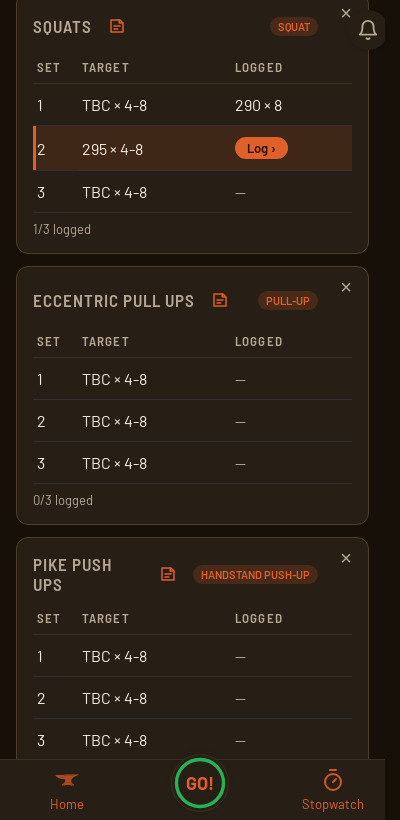
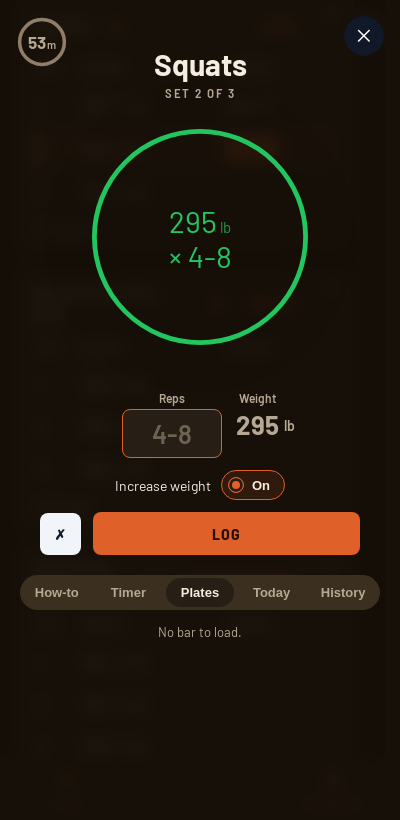
Start Bodyweight Basic Routine in Iron Forge
FAQ
- Why does everything start at the easiest variation?
Because the source's starting rule is a self-test done in the gym — find the variation you can just about manage 4 reps of, then drop back one — and that is a judgement the app cannot make for you. Move yourself up the ladder in your first session or two; after that the one-rep-per-session rule takes over.
- When do I move to the next variation?
When you complete 3 sets of 8 with good form. You then restart the new variation at 3 sets of 4. For the plank, move on once you can hold one minute.
- Do I do push-ups and dips in the same session?
No — you alternate. That is what Workout A and Workout B are: identical except that A carries the push-up slot and B the dip slot.
- What if I have nowhere to do dips?
The source says to skip dips altogether and do push-ups exclusively. Swap the dip slot for the push-up progression if you need to.
- Is this the same as the Recommended Routine?
No, though they are cousins. Both are ladder-based full-body calisthenics run three times a week. This one is shorter — seven slots, 3 sets of 4-8 throughout — and progresses on a strict one extra rep per session.
- Do I need any equipment?
A pull-up bar, something to dip from (parallel bars, or a bench for the early rungs), and a chair or bench. The source lists dip bars as optional and offers alternatives.
- The variation I am on is too hard. What do I do?
Work it for more reps rather than dropping it: build up to three sets of twelve on the variation below the one that is beating you. If that still does not get you to three sets of four on the harder one, three sets of three is an acceptable place to build from. What you should not do is skip the variation — the ones after it are usually built on top of it.
- A variation is far too easy. Can I skip it?
Start it at three sets of six instead of four and move through it quickly, but do not skip it altogether. The source is firm on that: the easy rungs are the basis for the ones that follow, and hopping over them tends to show up two variations later.
- I have stopped progressing. What now?
Ignore one bad session — everyone has them. If you fail to progress more than twice in a row, take an extra rest day and start that movement again from a lower rung. That is the whole deload here, and it applies to one ladder at a time rather than to the week.
- How fast should the reps go up?
One rep a session, and no faster — 4,4,4 becomes 5,4,4, then 5,5,4, and so on to 8,8,8. The source calls that pace crucial. Sets are 4 to 8 reps with one to two minutes of rest, lifted at a controlled tempo: a second or two up, a pause, three seconds down.
Start Start Bodyweight Basic Routine for free today.
Real programs, done right. Log your lifts — Iron Forge handles the maths.