Proven program, faithfully implemented
RP Strength (Hypertrophy)
RP Strength is the hypertrophy framework from Mike Israetel and the Renaissance Periodization team. Unlike the strength-driven programmes (5/3/1, Juggernaut), it isn't built around a Training Max — it's built around weekly volume per muscle.
About the program
Created by: Dr. Mike Israetel — Renaissance Periodization — Scientific Principles of Hypertrophy Training.
- Creator: Dr. Mike Israetel — Renaissance Periodization
- App: RP Hypertrophy App
- Store: RP programs & books
RP Strength (Hypertrophy) is a trademark of its respective owner; Iron Forge is not affiliated with or endorsed by them.
Who it's for
- Best for: Size. RP is a pure hypertrophy framework — strength gains are incidental.
- Experience: Intermediate. You need 1-2+ years of consistent training to get value from RP — enough to judge RIR honestly (most newer lifters think they're at RIR 1 when they're actually at RIR 4), pick your own working weights confidently, and engage with the weekly feedback loop. If you're earlier than that, BLS or 5/3/1 will build more strength faster — come back to RP once your lifts plateau and you want a dedicated muscle-building phase.
- Time: 4-6 week mesocycles ending in a deload, 2-6 sessions per week (depends on the split).
How you can run it
RP Strength (Hypertrophy) runs eight ways, and you pick which one when you start it — Iron Forge builds the sessions to match.
- Upper / Lower · 2 days
- Upper / Lower · 4 days
- Push / Pull / Legs · 3 days
- Push / Pull / Legs · 6 days
- Bro split · 5 days
- Bro split · 6 days
- Full Body · 3 days
- Full Body · 4 days
How it's built
The shape of the program — sessions, sets and rep scheme. Iron Forge fills in the exact weights for you from your maxes. Shown below: the Full Body · 3 days layout — see “How you can run it” above for the rest.
Mesocycle
Full Body 1
- Chest — 4×8-20
- Front Delts — 3×8-20
- Side Delts — 4×8-20
- + 6 more exercises
Full Body 2
- Chest — 4×8-20
- Back — 4×8-20
- Side Delts — 4×8-20
- + 7 more exercises
Full Body 3
- Back — 4×8-20
- Front Delts — 3×8-20
- Rear Delts — 3×8-20
- + 6 more exercises
How Iron Forge runs it
How it works
RP Strength is a hypertrophy framework: instead of a Training Max and a heavier bar each week, it programmes how many hard sets each muscle gets per week. You pick a split and how many sessions a week you can train, work each muscle in the 8–12 rep range on compounds and 12–20 on isolation, and stop each set a target number of reps short of failure — you choose the weight that makes that land. Volume climbs for 4 to 6 weeks, then a deload week clears the fatigue and the next block starts.
Here's the thing about building muscle: across every honest study we have, the single variable that tracks growth best is how many hard sets you do per muscle per week. Not the magic exercise, not the perfect rep tempo, not which split has the coolest name — weekly volume, taken close enough to failure, recovered from, and repeated. That's the whole game.
So RP doesn't programme a Training Max and chase a heavier bar like the strength programmes do. It programmes volume per muscle, ramps it up over a few weeks until you're doing about as much as you can recover from, then backs off and does it again. Strength comes along for the ride — but size is the target.
Volume landmarks
Every muscle has a working range of weekly sets, and we mark it with three landmarks:
- MEV — Maintenance/Minimum Effective Volume. The fewest hard sets per week that still grows the muscle. Below this you're just maintaining. This is where a mesocycle starts.
- MAV — Maximum Adaptive Volume. The sweet spot where most of your weekly sets should live for most of the block — enough stimulus to grow well without burying your recovery.
- MRV — Maximum Recoverable Volume. The most you can do and still recover. Push past it and you accumulate fatigue faster than you adapt — that's junk volume, and it costs you. A mesocycle peaks just shy of here.
These numbers are individual — your back's MRV is not your neighbour's — so the app stores them per muscle, per user and tunes them over time from your feedback. Don't agonise over the exact starting figures; the autoregulator's job is to dial them in.
How the volume goes up
A mesocycle runs 4 to 6 weeks. You start each muscle at its MEV and add a little volume each week, climbing toward MRV — something like 12 → 14 → 16 → 18 sets across the block (illustrative; your real numbers are per-muscle). Week by week the work piles up and so does fatigue, which is exactly the point: you're driving a bigger and bigger stimulus right up to the edge of what you can recover from.
Then the last week is a mandatory deload — volume and intensity drop hard so fatigue dissipates and the gains you earned can actually show up. Skipping the deload doesn't make you tougher; it just digs a hole. Ramp, peak, deload, repeat.
At the end of each week you fill out a quick per-muscle survey — pump, soreness/disruption, and performance, across all the muscle groups. The autoregulator reads that feedback and nudges next week's volume per muscle: a muscle that's barely pumped and never sore gets more sets; one that's beaten up and under-recovering gets held back or trimmed. This is how the generic landmark numbers become your landmark numbers — the programme meets your recovery where it actually is instead of where a textbook guessed.
How hard each set is
You don't take every set to failure — you leave Reps In Reserve (RIR): the number of reps you could still have done with good form. RIR is how RP manages intensity alongside volume, and it drops as the block goes on. Early weeks sit around RIR 3 (volume is climbing, so keep effort honest but submaximal); by the last hard week you're near RIR 0–1, grinding. As volume ramps up, proximity to failure ramps with it, then the deload resets both.
Judging RIR honestly is a learned skill — most newer lifters call "RIR 1" when they had four reps left. If your RIR estimates are wild, your whole block drifts. That's the main reason RP rewards a couple of years of training experience.
Sessions and splits
Within a single session there's a point of diminishing returns per muscle. Roughly: ~3 sets is a minimal dose, around 8 sets is about optimal, and by 10–12 sets in one session it's junk — more fatigue, no more growth. So the app caps per-muscle work in a session and spreads the rest across the week. If you want more weekly volume, the answer is almost always another session, not cramming more into today.
Once weekly volume gets meaningful, you can't pile it all onto one day — the per-session ceiling won't allow it and the quality craters. You add volume by adding frequency. Pick a split (Upper/Lower, PPL, Bro, or Full Body) and a sessions-per-week count; each split only offers the frequencies that actually distribute the work sensibly, so the picker hides the rest.
High-frequency setups rotate emphasis — you don't blast every muscle maximally every day. Full Body here trains each muscle about twice a week with the emphasis moving session to session, rather than 14 muscles every workout. The split you choose matters far less than hitting your weekly volume with enough frequency to keep each session productive.
How a session looks
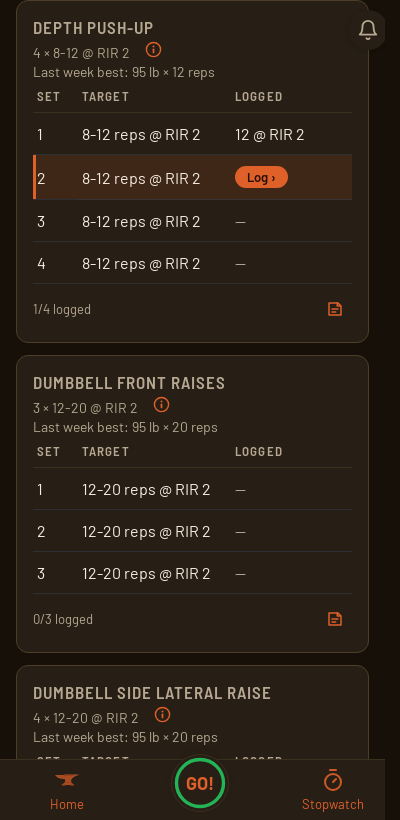
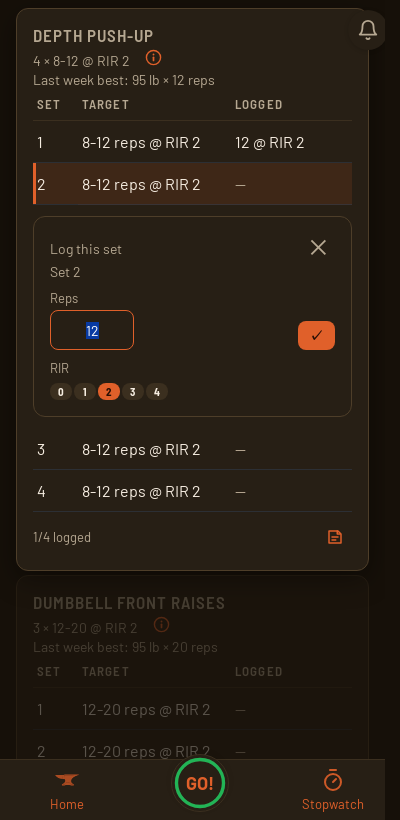
A workout is a list of exercises grouped by muscle (a Push day might be chest / front delts / triceps). Every set runs at this week's RIR target — no AMRAP — in a hypertrophy rep range: 8–12 reps on compounds and 12–20 on isolation work. The programme controls sets, reps, and RIR; you pick the load. The first time you train a movement the weight field is pre-filled with a suggestion from your history (scaled to the rep + RIR target); after that it carries your last weight forward. Treat it as a starting point and adjust at the bar so the prescribed reps land at the prescribed RIR.
Rest as long as you need to keep quality high: roughly ~5 min on heavy compounds, ~2 min on moderate work, ~1 min on isolation. Rushing rest just lowers your reps and muddies the stimulus.
RP Strength (Hypertrophy) in Iron Forge
FAQ
- What do MEV and MRV mean?
MEV = Minimum Effective Volume, the fewest weekly sets that still grow a muscle. MRV = Maximum Recoverable Volume, the most it can recover from. A mesocycle ramps each muscle from around MEV up toward MRV, then deloads.
- What is RIR and why does it change?
Reps In Reserve — how many reps you leave in the tank. You start a mesocycle with higher RIR (further from failure) and reduce it week by week as volume climbs, so effort rises alongside the volume.
- How does the volume progress?
You add sets (and sometimes a little load) per muscle each week, climbing from MEV toward MRV, until the deload week drops volume right down to clear fatigue.
- Why do I rate soreness and pump each week?
That weekly feedback autoregulates the plan: a muscle recovering well earns more sets next week, a beaten-up one gets held or cut. The programme adapts volume to how you're actually recovering.
- What rep range and weights do I use?
Eight to twenty, and which end depends on the movement: compound work sits at 8 to 12, isolation work at 12 to 20. The weight is whatever lands those reps at the RIR prescribed for that week, chosen at the bar rather than from a percentage. Load is never dictated here — effort and weekly volume are.
- How long is a mesocycle?
Five weeks here: four of climbing volume and falling reps in reserve, then a deload. After it you start a new block, often from a slightly higher set count than last time as your work capacity grows.
- Can I choose a different split?
Yes — upper/lower twice or four times a week, push-pull-legs three or six times, a five- or six-day body-part split, or full body three or four times. Full body three times a week is the default because it hits each muscle often enough for the volume ramp to actually happen; on a split where a muscle trains once a week, the weekly set climb has nowhere to go.
- Why does it choose my exercises for me?
Because what it prescribes is sets per muscle, not a fixed movement list — that is the whole method. Each slot names a muscle and the app fills it from the equipment you told it you have. If you want a different movement in a slot, swap it; the volume for that muscle is what the plan is tracking, not which exercise delivered it.
Start RP Strength (Hypertrophy) for free today.
Real programs, done right. Log your lifts — Iron Forge handles the maths.