Proven program, faithfully implemented
Overcoming Gravity
Overcoming Gravity is Steven Low's bodyweight strength and skill system. Like the Recommended Routine it progresses by moving up a ladder of harder variations rather than adding weight — but it reaches further, toward gymnastic skills like the handstand, planche, front lever, one-arm pull-up and pistol squat. This app ships a sensible default full-body routine built on Overcoming Gravity's principles; the fuller framework (your own exercise choices, splits and periodisation) is something you layer on as you advance.
About the program
Created by: Steven Low — Overcoming Gravity (2nd ed.).
- Creator: Steven Low (official site)
- Book + free charts: Overcoming Gravity (2nd ed.)
- Buy: Overcoming Gravity (Amazon)
Who it's for
- Best for: Building strength alongside gymnastic skills (handstand, planche, front lever, one-arm pull-up) with little equipment.
- Experience: Beginner to advanced — the ladders start very easy and run all the way to elite skills.
- Time: 8-week block, 3 sessions per week with a rest day between.
How it's built
The shape of the program — sessions, sets and rep scheme. Every set here is bodyweight — Iron Forge tracks the level you are on and moves you up when you have earned it.
8 weeks
Full Body A
- Wall Plank — 3×8-12
- Frog Stand — 3×8-12
- Tuck Front Lever — 3×8-12
- + 7 more exercises
Full Body B
- Wall Plank — 3×8-12
- Frog Stand — 3×8-12
- Tuck Front Lever — 3×8-12
- + 7 more exercises
Full Body C
- Wall Plank — 3×8-12
- Frog Stand — 3×8-12
- Tuck Front Lever — 3×8-12
- + 7 more exercises
How Iron Forge runs it
How it works
Three full-body sessions a week, each run in the order Overcoming Gravity recommends — hardest, most technical work while you're fresh, then strength:
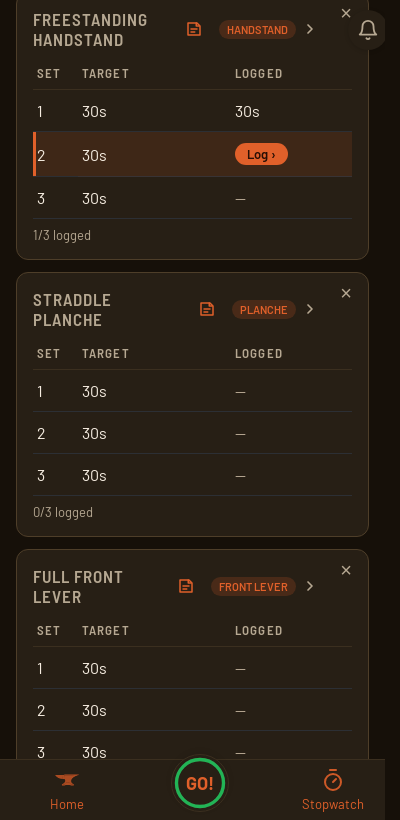
- Skill / static holds first — handstand, planche and front lever, trained while you're fresh because they demand the most control.
- Paired antagonist strength — vertical push/pull (handstand push-up + pull-up→one-arm), horizontal push/pull (dips + rows→front-lever rows), then legs (squat→pistol + hinge→nordic).
- Core — the L-sit → manna line to finish.
Each movement is 3 sets. Strength moves run 3×5–8 reps (the "Rule of 15" — roughly 15 total quality reps); the skill, static and core holds run 3×10–30 seconds.
Moving up the ladder
Each movement sits on a ladder of variations from easiest to hardest. You stay on a variation until you own it, then move up:
- Clear the top of the range on every set (e.g. 3×8, or a 30-second hold ×3) → advance to the next harder variation and reset to the bottom of the range.
- Can't reach the bottom of the range on any set → drop back to the previous variation.
- Anywhere in between → stay put and keep working.
The app tracks your position on every ladder independently, so when a movement advances, the rest of your sessions update to the new variation automatically. Your positions carry over to your next block.
Schedule and equipment
An 8-week block, 3 sessions a week (24 full-body workouts), with at least one rest day between sessions.
"No kit" means "minimal kit": the floor, a wall, and a pull-up bar get you most of the way. Parallettes or parallel bars (for dips, L-sits and planche work) and gymnastic rings unlock the full skill ladders. You can start without them and substitute the floor variations until you add them.
Overcoming Gravity in Iron Forge
FAQ
- What is Overcoming Gravity based on?
Steven Low's book of the same name — a systematic framework for bodyweight/gymnastic strength training. This routine is an opinionated default built from its principles.
- How do I progress with no weights?
By advancing along each movement's progression — from an easier variation to a harder one. Clear the target on a variation → step up to the next; too hard → step back down.
- Why is skill/static work done first?
Handstands, planche and front-lever work need a fresh nervous system for quality practice, so they go early in the session before the more fatiguing strength work.
- What rep ranges does it use?
A few hard sets in a low-to-moderate rep range for strength movements, and accumulated time for static holds. Skill work is practised for quality rather than to failure.
- Is this for beginners?
It suits motivated beginners through intermediates, but it's more demanding and skill-heavy than the Recommended Routine. If you're brand new to calisthenics, the RR is a gentler on-ramp.
- Can I customise the splits and progressions?
The book's framework is highly customisable; this in-app version ships an opinionated full-body default. Fuller configurability is planned — for now the default gives a complete, coherent structure.
- Why is a hold shown as reps?
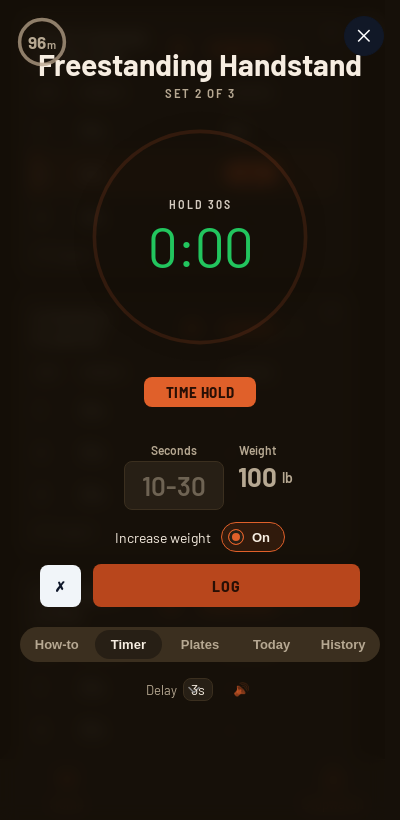
Because the app counts reps, and the holds are written as sets of them rather than as seconds. Read them as what the book prescribes: ten to thirty seconds per set, working toward about fifteen seconds of good quality. When you can hold the top of that comfortably on every set, you have earned the next variation.
- How long is it and how often do I train?
Eight weeks, three sessions a week, with at least one rest day between them — twenty-four workouts in all. The sessions are identical, so what changes over the block is which variation of each movement you are on.
- Is there a deload?
None is scheduled, because the ladder does that job. If a variation is beating you, you step back down to the previous one and rebuild — that is the deload, applied to one movement at a time instead of the whole week. If everything is beating you at once, take the week off; nothing here is spoiled by it.
Start Overcoming Gravity for free today.
Real programs, done right. Log your lifts — Iron Forge handles the maths.