Proven program, faithfully implemented
Juggernaut
Juggernaut is a strength training programme created by Chad Wesley Smith, founder of Juggernaut Training Systems. It's a periodized programme designed for athletes and intermediate-to-advanced lifters who want higher volume than 5/3/1.
About the program
Created by: Chad Wesley Smith — The Juggernaut Method 2.0.
Who it's for
- Best for: Strength, with significant size as a side-effect of the volume.
- Experience: Intermediate to advanced. You should have at least 1-2 years of consistent barbell training, a solid 1RM estimate on the four main lifts, and the work capacity to handle high-rep squats and deadlifts without form falling apart. New lifters will get more out of 5/3/1 or BLS first.
- Time: 16-week training block (4 waves × 4 weeks), 4 sessions per week.
How you can run it
Juggernaut runs three ways, and you pick which one when you start it — Iron Forge builds the sessions to match. All three run 4 days a week.
- Inverted accumulation (10s/8s)
- Going Heavy — heavy top set every week
- Going Heavy (light) — heavy top set on Intensification only
How it's built
The shape of the program — sessions, sets and rep scheme. Iron Forge fills in the exact weights for you from your maxes. Shown below: one of the three layouts — see “How you can run it” above for the rest.
Wave: 10s
Bench
- Barbell Bench Press
- + 4 more exercises
Squat
- Barbell Squat
- + 4 more exercises
Deadlift
- Deadlift
- + 4 more exercises
Press
- Overhead Press
- + 4 more exercises
Wave: 8s
Bench
- Barbell Bench Press
- + 4 more exercises
Squat
- Barbell Squat
- + 4 more exercises
Deadlift
- Deadlift
- + 4 more exercises
Press
- Overhead Press
- + 4 more exercises
Wave: 5s
Bench
- Barbell Bench Press
- + 4 more exercises
Squat
- Barbell Squat
- + 4 more exercises
Deadlift
- Deadlift
- + 4 more exercises
Press
- Overhead Press
- + 4 more exercises
Wave: 3s
Bench
- Barbell Bench Press
- + 4 more exercises
Squat
- Barbell Squat
- + 4 more exercises
Deadlift
- Deadlift
- + 4 more exercises
Press
- Overhead Press
- + 4 more exercises
How Iron Forge runs it
How it works
Juggernaut is a 16-week strength block you run four days a week — one main barbell lift per session (bench, squat, deadlift and overhead press), plus that day's assistance. Every main-lift set is a percentage of your Training Max, which you set at about 90% of a recent 1-rep max.
The 16 weeks are four 4-week waves — 10s, 8s, 5s, then 3s — running in order and getting heavier as the reps come down. Every wave walks through the same four phases: accumulation (volume), intensification (heavier), realization (the test), and a deload to clear the fatigue before the next wave starts.
Most phases finish with an AMRAP set — as many reps as possible — and the realization AMRAP is the one that counts: the reps you hit there are scored against a target and set your training max for the next wave. You earn your progress rather than adding a fixed amount every week.
How your training max goes up
Unlike 5/3/1's fixed TM increments, Juggernaut adjusts your Training Max after every realization AMRAP based on what you actually hit. The formula:
New TM = Old TM + (Extra Reps x Increment)
Extra reps above the minimum drive your TM up; just hitting the target keeps it the same. This means your progress is based on real performance, not assumption.
The waves and phases
| Term | In Juggernaut | Duration |
|---|---|---|
| Microcycle | One phase (one week of training in a wave) | 1 week |
| Mesocycle | One wave (4 phases: accumulation, intensification, realization, deload) | 4 weeks |
| Macrocycle | One training block (4 waves: 10s, 8s, 5s, 3s) | 16 weeks |
The 4 waves
Each macrocycle is built from 4 mesocycles (waves), named after the target rep range in their accumulation phase:
| Wave | Accum % | Top set | AMRAP target |
|---|---|---|---|
| 10s | 60% | 75% x 10+ | 10+ reps |
| 8s | 65% | 80% x 8+ | 8+ reps |
| 5s | 70% | 85% x 5+ | 5+ reps |
| 3s | 75% | 90% x 3+ | 3+ reps |
The 4 phases of each wave
- Accumulation — high volume at lower intensity. Last set is AMRAP.
- Intensification — moderate volume, ramping intensity. Last set is AMRAP.
- Realization — peak intensity with one heavy AMRAP at the top of the ramp.
- Deload — light recovery week (40/50/60% x 5). Same across all waves.
Full set-by-set scheme
Every set is a percentage of your Training Max (TM). Format is %TM × reps; a + marks the AMRAP set (the listed reps are the minimum to beat). Weights round to your plate setting and never drop below the bar. The deload (40/50/60% × 5) is the same in every wave.
Wave 1 — 10s
| Phase | Sets (%TM × reps) |
|---|---|
| Accumulation | 60×10, 60×10, 60×10, 60×10, 60×10+ |
| Intensification | 55×5, 62.5×5, 67.5×10, 67.5×10, 67.5×10+ |
| Realization | 50×5, 60×3, 70×1, 75×10+ |
| Deload | 40×5, 50×5, 60×5 |
Wave 2 — 8s
| Phase | Sets (%TM × reps) |
|---|---|
| Accumulation | 65×8, 65×8, 65×8, 65×8, 65×8+ |
| Intensification | 60×3, 67.5×3, 72.5×8, 72.5×8, 72.5×8+ |
| Realization | 50×5, 60×3, 70×2, 75×1, 80×8+ |
| Deload | 40×5, 50×5, 60×5 |
Wave 3 — 5s
| Phase | Sets (%TM × reps) |
|---|---|
| Accumulation | 70×5, 70×5, 70×5, 70×5, 70×5, 70×5+ |
| Intensification | 65×2, 72.5×2, 77.5×5, 77.5×5, 77.5×5, 77.5×5+ |
| Realization | 50×5, 60×3, 70×2, 75×1, 80×1, 85×5+ |
| Deload | 40×5, 50×5, 60×5 |
Wave 4 — 3s
| Phase | Sets (%TM × reps) |
|---|---|
| Accumulation | 75×3 ×6 sets, 75×3+ (7 sets) |
| Intensification | 70×1, 77.5×1, 82.5×3, 82.5×3, 82.5×3, 82.5×3, 82.5×3+ |
| Realization | 50×5, 60×3, 70×2, 75×1, 80×1, 85×1, 90×3+ |
| Deload | 40×5, 50×5, 60×5 |
An optional inverted accumulation swaps sets and reps in the 10s and 8s waves for cleaner technique. See the help topic for details.
Want it heavier? The Going Heavy option
The base programme is deliberately submaximal — in the 10s wave you squat 5×10 at 60% — and the commonest complaint about it is that it never feels heavy. Chad Wesley Smith answered that himself, and Going Heavy is his answer, not ours.
Pick it under Programme option when you start a block. There are two:
- Going Heavy — every week opens with a heavy top set, and the normal Juggernaut sets behind it are taken at their minimum reps.
- Going Heavy (light) — the heavy set lands on Intensification week only; Accumulation and Realization run exactly as written.
The heavy set tracks the wave: a heavy 5 in the 10s wave, 3 in the 8s, 2 in the 5s, 1 in the 3s. It has no prescribed weight — you work up to a challenging set on the day.
The rules that come with it
- Make every rep. Making reps makes you stronger; missing them doesn't.
- Keep the heavy set around an effort of 8–9.5 — challenging, not a true max.
- On Intensification week you can skip the ramp-up sets; the heavy work has already warmed you up.
- Your normal sets drop to the minimum reps on purpose. You are not chasing reps twice in one session — that is the trade.
- Expect it to blunt your Realization AMRAP slightly. Smith says so up front. You are buying heavy exposure with a little of your training-max progress; that is the deal, not a fault.
Realization week keeps its AMRAP in both options, because that set is what moves your training max into the next wave.
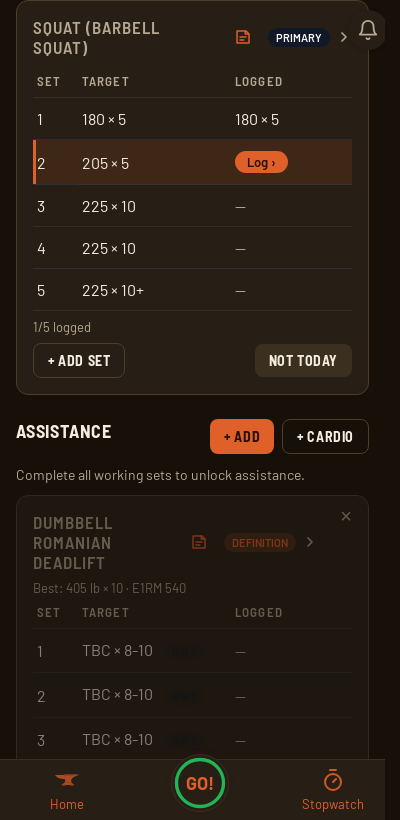
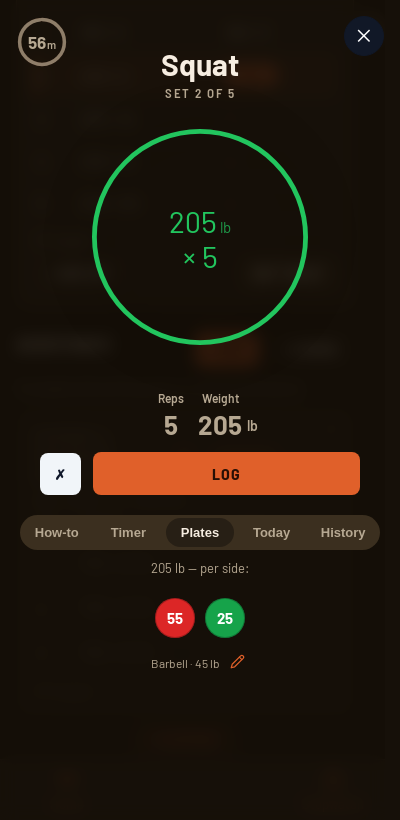
Juggernaut in Iron Forge
FAQ
- Who is this program for?
Intermediate to advanced lifters who have run out of road on simple add-weight-every-session programmes and need a longer wave to keep progressing. Chad Wesley Smith built it as a strength programme with real hypertrophy work included, so it fits people who want to get stronger on bench, squat, deadlift and press without giving up bodybuilding-style assistance. If you're a true beginner, a linear programme will add weight faster — come to Juggernaut once that stalls.
- What training max should I start with?
About 90% of a true, recent 1-rep max for each lift — or a conservative estimate if you're unsure. The realization AMRAPs reward reps, so a slightly light TM still progresses quickly and is safer than starting too heavy.
- How does my training max go up?
It's performance-based. The last wave phase is a Realization week with a top AMRAP set; the reps you hit there are scored against a target and set your next training max. Big AMRAP → bigger jump; a miss holds or reduces the TM. You earn progress rather than adding a fixed amount every week.
- How many days a week is it?
Four — one main lift per training day (bench, squat, deadlift, overhead press), plus that day's assistance.
- What are the four waves and phases?
Four waves — 10s, 8s, 5s, 3s — run in order, getting heavier. Each wave is four phases: Accumulation (volume), Intensification (heavier), Realization (the AMRAP test), and Deload (recover before the next wave).
- What is inverted accumulation?
An optional variant for the 10s and 8s waves that reverses how the accumulation sets/reps build, front-loading more volume. It's off by default; turn it on when you create the block if you want it.
- What if I miss my rep target on the AMRAP?
Nothing breaks — the AMRAP is the measurement. A miss simply means your training max holds (or steps back slightly) so the next wave lands at a weight you can actually move for reps. That self-correction is the point of the method.
- Can I choose my own assistance exercises?
Assistance is filled from muscle-category slots (e.g. chest/triceps/core) rather than fixed lifts, and the picked exercises are amendable when you start the block — so you can swap them to suit your equipment and preferences.
- How do the deloads work?
Every wave ends with a deload phase before the next, heavier wave begins. The main lift drops to lighter percentages of your training max, and your assistance is cut to roughly half its usual sets at the same working load — that accessory volume cut is the book's deload. It's there to clear accumulated fatigue so you turn up fresh for the next realization AMRAP, not to test anything. Don't skip it.
- What are the most common mistakes?
Three big ones. Starting with too heavy a training max — the AMRAPs expose it straight away and your progression stalls; err lighter than your ego wants. Grinding the realization AMRAP into ugly, near-failure reps — stop with good form and about a rep left, it's a measurement rather than a max-out. And short-changing the deload or the assistance — the deload keeps the waves repeatable, and the assistance volume drives the size half of the programme.
Start Juggernaut for free today.
Real programs, done right. Log your lifts — Iron Forge handles the maths.