Proven program, faithfully implemented
Hypertrophy-Specific Training
Hypertrophy-Specific Training runs an eight-week macrocycle in two-week blocks — the 15s, the 10s, then the 5s — where each block's LAST session is your rep max for those reps and every earlier session is a step below it. ⚠ It ends in Strategic Deconditioning: nine to sixteen days of no lifting at all, which is the design rather than a deload.
About the program
Created by: Bryan Haycock — Setting up a Hypertrophy-Specific Training Cycle, by Charles T. Ridgely (Think Muscle).
- The published cycle this definition was built from: Setting up a Hypertrophy-Specific Training Cycle — Think Muscle
Who it's for
- Best for: Size, run as a planned cycle with a real end — including a break most programmes never prescribe.
- Experience: Intermediate to advanced. You need a 15RM, 10RM and 5RM for every exercise before you start, and the discipline to lift submaximally for weeks.
- Time: Eight weeks of three full-body sessions a week, then 9-16 days off before the next macrocycle.
How it's built
The shape of the program — sessions, sets and rep scheme. Iron Forge fills in the exact weights for you from your maxes.
The 15s
Full body 1
- Barbell Squat — 1×15
- + 6 more exercises
Full body 2
- Barbell Squat — 1×15
- + 6 more exercises
Full body 3
- Barbell Squat — 1×15
- + 6 more exercises
The 10s
Full body 1
- Barbell Squat — 2×10
- + 6 more exercises
Full body 2
- Barbell Squat — 2×10
- + 6 more exercises
Full body 3
- Barbell Squat — 2×10
- + 6 more exercises
The 5s
Full body 1
- Barbell Squat — 3×5
- + 6 more exercises
Full body 2
- Barbell Squat — 3×5
- + 6 more exercises
Full body 3
- Barbell Squat — 3×5
- + 6 more exercises
More 5s
Full body 1
- Barbell Squat — 3×5
- + 6 more exercises
Full body 2
- Barbell Squat — 3×5
- + 6 more exercises
Full body 3
- Barbell Squat — 3×5
- + 6 more exercises
Strategic Deconditioning
How Iron Forge runs it
How it works
Hypertrophy-Specific Training: an eight-week macrocycle of two-week mesocycles — the 15s, the 10s, the 5s, then a final block — trained three full-body sessions a week.
Strategic Deconditioning
The macrocycle closes with 9 to 16 days of NO LIFTING AT ALL. ⚠ It is not a deload and must not be treated as one — the point is to let the muscles become deconditioned to the heavy loads so the next macrocycle works again.
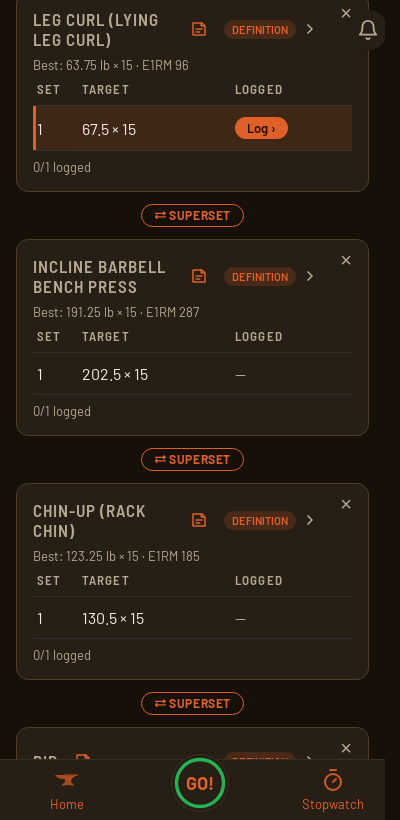
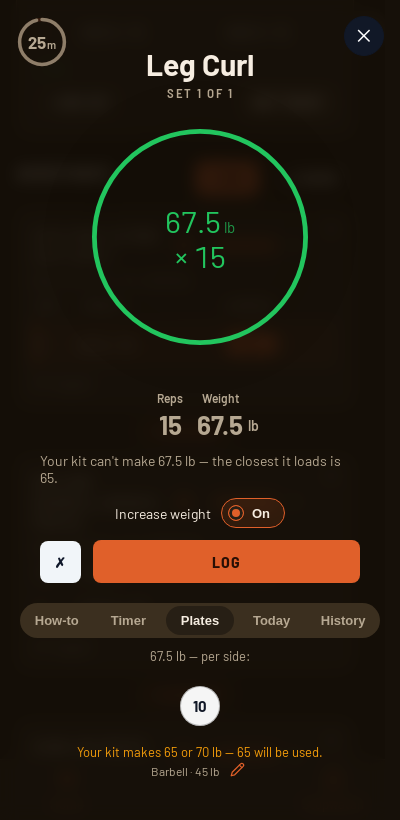
Hypertrophy-Specific Training in Iron Forge
FAQ
- Why does the weight start so light?
Because every block ramps TO a known rep max rather than starting at it. The source's own example: a 15RM of 120 with a 5RM of 160 gives a decrement of 8, so the 15s run 80, 88, 96, 104, 112, 120 across six workouts.
- How do I find my 15RM, 10RM and 5RM?
Test them before you start — they are the inputs the whole macrocycle is computed from. An estimate that is too high makes the last workout of a block unmakeable.
- Why one decrement for all three blocks?
It is what the source prescribes: about 5% of your 5RM, one figure per exercise, applied in the 15s, the 10s and the 5s alike.
- Is the two weeks off really necessary?
The source treats it as part of the programme, not a break from it — "between 9 to 16 days of no lifting". Skipping it means starting the next macrocycle still conditioned to the loads it is meant to reintroduce.
- Can I train more than three times a week?
Each mesocycle is "at least six individual workouts" over two weeks — three a week. The load ramp is built around that count.
- What happens in weeks 7-8?
Six more sessions at your 5RM. The source offers four ways to spend those two weeks — negatives off a 2RM, drop sets, creeping on to a 4RM or 3RM, or simply carrying on with your 5RM weights, which it calls heavy enough to remain productive — and endorses none of them as the default. This ships the last, because it is the only one that needs neither a training partner nor a rep-max you were never asked for. It is written as a ramp with a step of zero, so the weight holds where the 5s left it.
- The weights aren't round numbers. Am I meant to load 96.5 kg?
No — round at the bar. The step is 5% of a weight you actually lifted, so it almost never lands on plate increments, and the arithmetic is deliberately left exact rather than rounded. Rounding the step would move every session off the source's numbers, and rounding the result would drift the last session off the very rep-max the ramp exists to arrive at. The source has you work this out in your own training log and do the same thing.
- How many sets should I do?
One set in the 15s, two in the 10s, three in the 5s. Worth knowing where that comes from: the method deliberately prescribes no volume at all — "use as much volume as you can while still remaining healthy" — and prints several worked examples instead. This is its second, the one it introduces as a beneficial amount, and the most conventional of them. Treat it as a starting point rather than a rule.
- What do I enter for chins and dips?
The weight you ADD, not your bodyweight. If you train them with a belt, enter the added load for each rep-max. If you train them unweighted, leave those fields blank and the sets will carry no prescribed weight — you take them as they come, the way any bodyweight set works.
- Why doesn't the weight change when a session goes badly?
Because nothing here reacts to a single session, and that is the method rather than a limitation. Every one of the 24 workouts is computed from your rep-maxes before you start, and the point is a steadily rising load over eight weeks rather than a number chased on the day. If a session falls short the app will tell you it did; it will not rewrite the ramp underneath you.
- What happens after the two weeks off?
You test your rep-maxes again and start a new run from the new numbers. That is why the macrocycle ends at the layoff instead of rolling straight into another one: the deconditioning is what makes those weights a stimulus again, and re-testing after it is part of the method rather than an optional check.
Start Hypertrophy-Specific Training for free today.
Real programs, done right. Log your lifts — Iron Forge handles the maths.