Proven program, faithfully implemented
German Volume Training
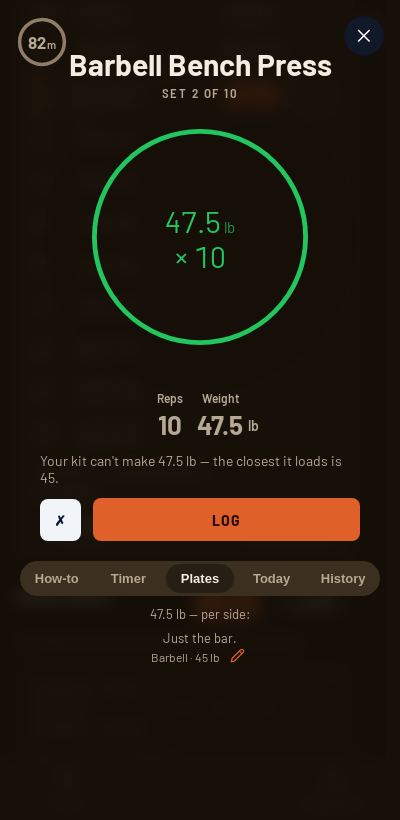
German Volume Training is the 10×10 method: one exercise per muscle group, ten sets of ten, the same weight on every set at roughly 60% of your one-rep max, with rest kept to 60-90 seconds. The incomplete recovery is the stimulus rather than a side effect, and it is why the last sets are nothing like the first.
About the program
Created by: Charles Poliquin — his GVT variant of the German 10-sets method (Rolf Feser lineage) — Introduction to the German Volume Training (Poliquin, archived).
Who it's for
- Best for: A short, deliberately brutal hypertrophy block — not a way to train year-round.
- Experience: Advanced. It asks for real work capacity and recovery, and 100 reps at a fixed load punishes anyone still learning a movement.
- Time: A short block, three to four sessions a week. The sessions are long because the rest is timed.
How it's built
The shape of the program — sessions, sets and rep scheme. Iron Forge fills in the exact weights for you from your maxes.
GVT
Chest & Back
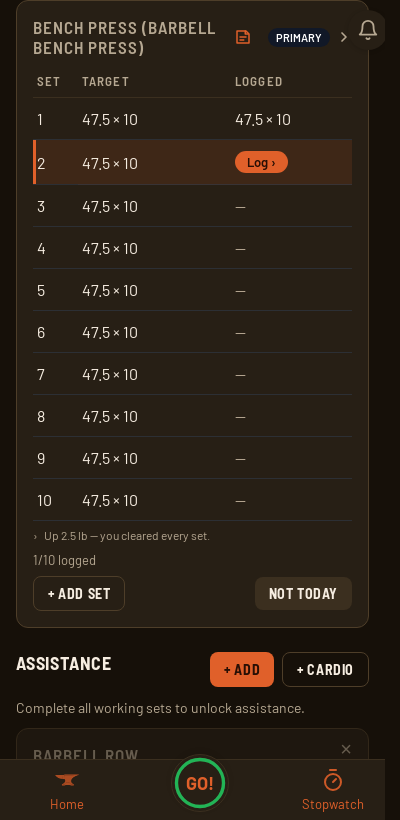
- Barbell Bench Press — 10×10
- + 3 more exercises
Legs & Abs
- Barbell Squat — 10×10
- + 3 more exercises
Shoulders & Arms
- Overhead Press — 10×10
- + 3 more exercises
How Iron Forge runs it
How it works
German Volume Training (GVT) is a brutal high-volume hypertrophy method built on the '10 sets of 10' scheme. For a given muscle group you pick one main exercise and do ten sets of ten reps with the SAME weight — about 60% of your 1-rep max — resting only a short, fixed period between sets. A little targeted accessory work rounds out the session. The sheer volume at a moderate load is the growth stimulus; early sets feel easy, later ones are a fight.
Load and progression
Start the 10×10 at roughly 60% of your 1RM (a weight you could do about 20 reps with fresh). Keep that weight for all ten sets even as they get hard. When you can complete all 100 reps (10 full sets of 10) with good form, add a fixed +5% next time. Because the load is moderate and fixed, progression is simply completing the volume, then nudging the weight.
Rest and structure
Rest is short and strictly timed (around 60–90 seconds) between the 10 sets — that incomplete recovery is part of what makes GVT so demanding and effective. Each session pairs two main 10×10 movements as an antagonist superset (e.g. Bench + Row — one per muscle group, alternated), plus a couple of lighter accessory exercises, on a split that lets each area recover before its next brutal volume day. It's a short-term specialisation block, not a year-round programme.
German Volume Training in Iron Forge
FAQ
- What is the 10×10?
Ten sets of ten reps of one exercise with the same weight (~60% 1RM) and short rests. It's the core of German Volume Training and the main driver of the hypertrophy stimulus.
- What weight should I use?
About 60% of your 1-rep max — roughly a 20-rep weight when fresh. It'll feel light for the first few sets and very hard by the last; that's expected. Keep it the same for all ten sets.
- How do I progress?
The app does it for you: complete all a hundred reps and the weight goes up 5% the following week. Fall short anywhere and it holds — there is no drop and no deload, because the method is to stay on a weight until every rep of it is clean.
- How long do I rest between sets?
Short and fixed — around 60–90 seconds. The incomplete recovery is deliberate and part of why the method works.
- Can I run GVT year-round?
No — it's a short specialisation block (typically a few weeks) because the volume is so taxing. Run it, then return to more moderate training.
- Is GVT good for beginners?
Not really — the volume is punishing and best used by intermediates who already have a base and can recover from it. Beginners grow fine on far less volume.
- Why are the two main lifts paired?
Because Poliquin pairs them — A-1 and A-2, an antagonist pair alternated set for set with about ninety seconds between them. You are not doing ten sets of bench and then ten sets of rows; you alternate, which is what makes twenty hard sets fit in a session at all.
- Is there a tempo?
Yes in the source, no in the app. Poliquin prescribes 4-0-2-0 on the 10×10 work — four seconds lowering, no pause, two seconds up — and the app does not track tempo, so it is yours to count. It matters more here than in most programmes: a fast tempo at 60% turns ten sets of ten into something much easier than intended.
- Do the accessories progress too?
No. Only the 10×10 lifts move automatically, because they are the fixed-rep work the method progresses. The three-set accessories are ranged, and they are left to you to load and push as you see fit.
- What happens after the six weeks?
You come off it. This is a specialisation block and the volume is the whole point, so it is not something to keep running — go back to moderate training, or follow Poliquin's own second phase of ten sets of six, which is not in the app. Either way, do not simply start the six weeks again.
Start German Volume Training for free today.
Real programs, done right. Log your lifts — Iron Forge handles the maths.