Proven program, faithfully implemented
Generic Bulking Routine
Lyle McDonald's Generic Bulking Routine is a four-day upper/lower split that splits each session by intent rather than by muscle: heavy compound work first at 3-4 sets of 6-8 with three minutes' rest, then lighter work at 2-3 sets of 10-12. It is deliberately unfussy — no waves, no percentages, no deload — and you progress by double progression, adding weight when you reach the top of the rep range.
About the program
Created by: Lyle McDonald — Lyle McDonald's Generic Bulking Routine, as published by JC Deen (jcdfitness.com).
- Creator: Lyle McDonald — BodyRecomposition
- The published routine this definition was built from: Lyle McDonald's Bulking Routine — JC Deen
Who it's for
- Best for: Size, while eating for it — a plain high-volume split with no periodisation to manage.
- Experience: Beginner to intermediate. The lifts are standard and the structure is simple; the volume is what makes it work.
- Time: Four days a week, lower/upper twice each. McDonald's own advice is to give it at least eight weeks.
How it's built
The shape of the program — sessions, sets and rep scheme. Iron Forge fills in the exact weights for you from your maxes.
Bulking block
Monday — Lower
- Squat — 3×6-8
- + 5 more exercises
Tuesday — Upper
- Bench Press — 3×6-8
- + 5 more exercises
Thursday — Lower
- Squat — 3×6-8
- + 5 more exercises
Friday — Upper
- Bench Press — 3×6-8
- + 5 more exercises
How Iron Forge runs it
How it works
Lyle McDonald's Generic Bulking Routine is a four-day upper/lower split: lower on Monday and Thursday, upper on Tuesday and Friday. Each day leads with heavy compound work at 3-4 sets of 6-8 with three minutes' rest, then lighter work at 2-3 sets of 10-12 with two minutes, and finishes with arms at 1-2 sets of 12-15.
Progression
Double progression: work within the rep range, and when you hit the TOP of it, add weight. ⚠ That instruction comes from JC Deen answering a reader in the article's comments, not from the article body — which prints the split and the schemes and nothing else about progression. It is why this programme is signed off as interpretation-faithful rather than author-faithful.
How long to run it
"I'd stick with it for at least 8 weeks" — again from the comments rather than the article. There is no built-in deload or end date.
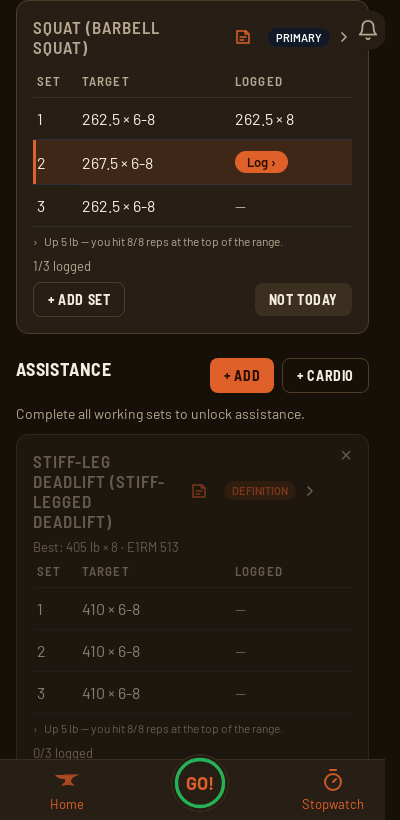
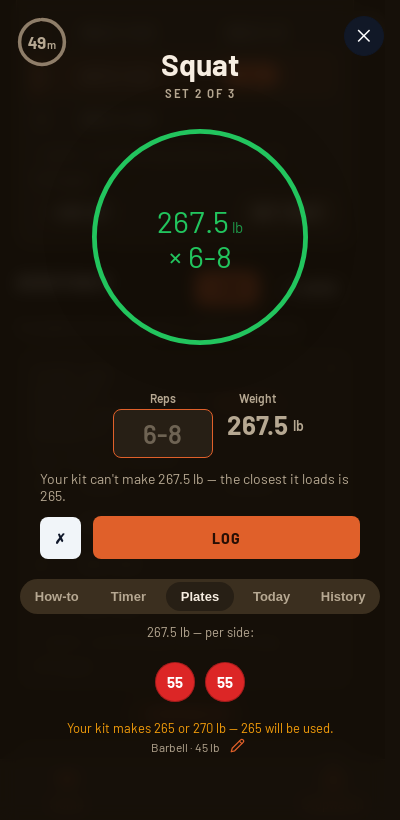
Generic Bulking Routine in Iron Forge
FAQ
- Why are Thursday and Friday the same as Monday and Tuesday?
Because the source says so: "For the Thu/Fri workouts either repeat the first two or make some slight exercise substitutions." Repeating is the option we ship; you can swap an exercise yourself any session.
- When do I add weight?
When you reach the top of the rep range on a lift — 8 on the heavy slots, 12 on the middle ones, 15 on arms. Then add weight and work back up the range.
- Why three different rep ranges in one session?
It is the shape of the routine: 6-8 for the main compounds, 10-12 for secondary work, 12-15 for arms, with rest periods of three, two and one and a half minutes respectively. The ranges and the rests are quoted from the source.
- Is there a deload?
No. The source prescribes none, so none is invented — you simply keep working the ranges. If a lift stops moving for a couple of weeks, take the weight back a step yourself and build through it again.
- Can I substitute exercises?
Yes — the source explicitly allows it for the Thursday/Friday sessions, and names a deadlift/leg-press combination and moving incline/pulldown to the front as examples.
- How heavy should I start?
Light enough to complete every set inside the rep range with good form. The source names no starting loads, so the app asks you or seeds from your maxes.
- What happens if I drop below the bottom of the rep range?
The weight comes down one increment so you can work back up. This is the one place the app speaks where the source does not — nothing in it says what to do about a bad session, so the standard double-progression step-down applies rather than leaving you stuck at a weight you cannot complete.
- The source says 3-4 sets. Why do I only see 3?
Because a range has to become a number somewhere, and the lower end is what ships — three sets on the heavy slots, two on the middle ones, one on arms. With three-minute rests on the main lifts, the extra set is what turns an hour into ninety minutes. Add it yourself on the days you have the time.
- Why a stiff-leg deadlift when the source says "SLDL or leg curl"?
Because the same day already prescribes "another leg curl" at 10 to 12 reps. Taking the leg-curl option in both slots would put one exercise in two roles at two different rep ranges, and the working weight is tracked per exercise, so the heavy and light loads would keep overwriting each other. Picking the SLDL option keeps each movement to one job.
- What are the triceps and biceps slots?
Whatever you choose. The source names no movement for either — just "triceps" and "biceps" at 12 to 15 reps — so the programme does not name one on your behalf.
- How long should I run it?
At least eight weeks, which is the author's own answer and what the programme is set up for. It is a bulking routine: it assumes you are eating to grow, and the progress comes from adding weight to the same twelve slots week after week rather than from changing the plan.
Start Generic Bulking Routine for free today.
Real programs, done right. Log your lifts — Iron Forge handles the maths.