Proven program, faithfully implemented
5/3/1 Building the Monolith
Building the Monolith is Jim Wendler's six-week size block on the 5/3/1 percentages. It is the volume outlier in the 5/3/1 family: the assistance is not a garnish but the point of it, written as a rep budget — one hundred chins, one hundred face pulls, however you get there. It also asks for a lower training max than standard 5/3/1, 85% rather than 90%, because week three works to 95% of it.
About the program
Created by: Jim Wendler — Building the Monolith — 5/3/1 for Size.
- Creator: Jim Wendler (official site)
- The programme: Building the Monolith — 5/3/1 for Size
- Store: All books & programs
Who it's for
- Best for: Size, on a barbell base — six weeks of deliberately high assistance volume rather than a strength peak.
- Experience: Intermediate to advanced. It assumes you already run 5/3/1 and know your training maxes, and the assistance volume is punishing if the four lifts are still new.
- Time: Six weeks, three days a week. Sessions are long — the assistance is the bulk of them.
How it's built
The shape of the program — sessions, sets and rep scheme. Iron Forge fills in the exact weights for you from your maxes.
Building the Monolith
Monday — Squat + Press
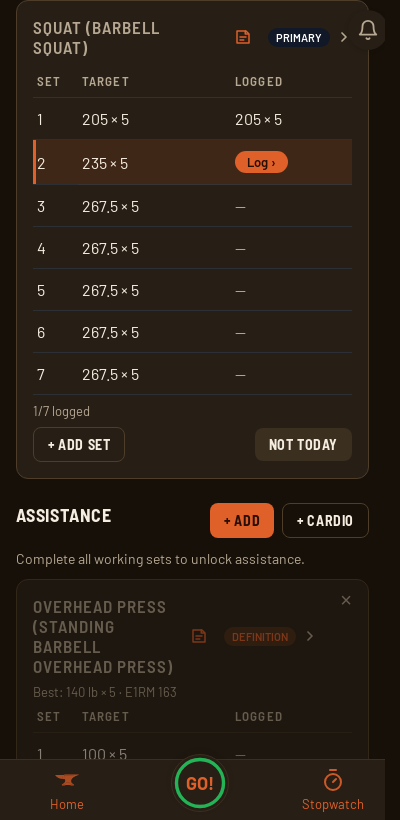
- Squat — 7×5
- + 4 more exercises
Wednesday — Deadlift + Bench
- Deadlift — 5×5
- + 3 more exercises
Friday — Squat + Press volume
- Squat — 3×5, 1×20
- + 3 more exercises
How Iron Forge runs it
How it works
Six weeks, three days a week, on the 5/3/1 percentages. Monday is squat and press, Wednesday is deadlift and bench, Friday is squat and a lot of pressing. It is a size block, and the assistance volume is the point of it.
⚠ Use 85% of your max as your training max, not 90%
Wendler is explicit: "If you are smart, run it for 6 weeks with a lower than you think TM (85%)." This is load-bearing rather than a nicety — week three works to 95% of the training max, and at a 90% TM that is 85.5% of a true max for sets of five, which is not runnable alongside this much assistance. Adjust your training maxes again before week four.
The one measured set
Monday's press finishes with an AMRAP, and it sits back at the FIRST percentage rather than on top of the ramp. It is the only rep-out in the whole programme.
The assistance is a rep budget
"100 total reps" means one hundred reps, however you get there — not five sets of twenty. Chins, face pulls, curls and shrugs are all written that way; dips are published as a range and take the midpoint. The one item Wendler does write as sets × reps, dumbbell rows at 5 × 10-20, stays that way.
5/3/1 Building the Monolith in Iron Forge
FAQ
- Why does it ask for 85% of my max instead of the usual 90%?
Because Wendler says to for this template: "you may have to adjust your Training Max to fit this template… run it for 6 weeks with a lower than you think TM (85%)". Week three goes to 95% of that number for sets of five, on top of a lot of assistance work. Entering a 90% training max makes the whole block heavier than he intended.
- Why is the AMRAP on the light press set rather than the heavy one?
Because that is where he puts it: Monday's press is 70×5, 80×5, 90×5, then a rep-out back at 70%. It is the only measured set in the programme, and moving it to the top set would change both what it measures and what the progression reads.
- Chins say one set of 100. Is that right?
Yes. It is a rep budget, not a prescription of sets — take the hundred reps in as many sets as it takes. Splitting it into 5×20 would be inventing an instruction the source does not give.
- Why does Friday's press have a different number of sets each week?
It is the one lift whose set count moves: 10, 10, 10, 12, 15 then 12 sets of five, at 70, 50, 75, 60, 65 and 75%. Both the volume and the intensity change week to week, which no single set list can express.
- What is the twenty-rep set on Friday?
The widowmaker — one set of twenty on the squat after the ramp. Its percentage climbs across the block: 45, 55, 55, 50, 65 then 70.
- Why does Monday's squat have five sets at the top but the deadlift only three?
Because the ramp is not uniform across the lifts and the source prints it that way. Squat and bench take five sets at the top percentage, the deadlift takes three. Tidying them into one shape would be a fidelity regression.
- Where is the conditioning?
In the source rather than in the app. Wendler asks for conditioning three to four times a week — prowler, weighted-vest walking, Air Dyne — and he is not treating it as optional; this is a size and general-preparedness block, and that work is half of what makes it one. None of it is prescribed here because none of it is a set the app could log honestly, and paraphrasing it would put words in his mouth. The same goes for the eating, which the original is just as direct about.
- What do I do when the six weeks are over?
Come out of it. This is a block, not a programme you keep running: six weeks, then back to whatever you train normally, with training maxes reset from where you actually are now. It is not built to be repeated back to back, and the app will not roll it into a second cycle for you.
- Do I need to change anything before week four?
Yes, and it is the easiest thing here to miss: adjust your training maxes again before the second half. Weeks four to six repeat the same percentage pattern as weeks one to three, so if the numbers you started with were even slightly generous, week six is week three with five weeks of fatigue behind it.
- Can I do band pull-aparts instead of face pulls?
Yes — they are the source's own alternative for that slot, not an extra exercise to fit in. A hundred reps of either, on Monday and again on Friday.
- Why 150 dips?
Because the source gives a range — 100 to 200 — and a number had to be logged, so the midpoint was taken deliberately rather than the top or the bottom. Treat it like the other hundreds: a budget for the session, broken into as many sets as it takes.
Start 5/3/1 Building the Monolith for free today.
Real programs, done right. Log your lifts — Iron Forge handles the maths.